Coenzyme
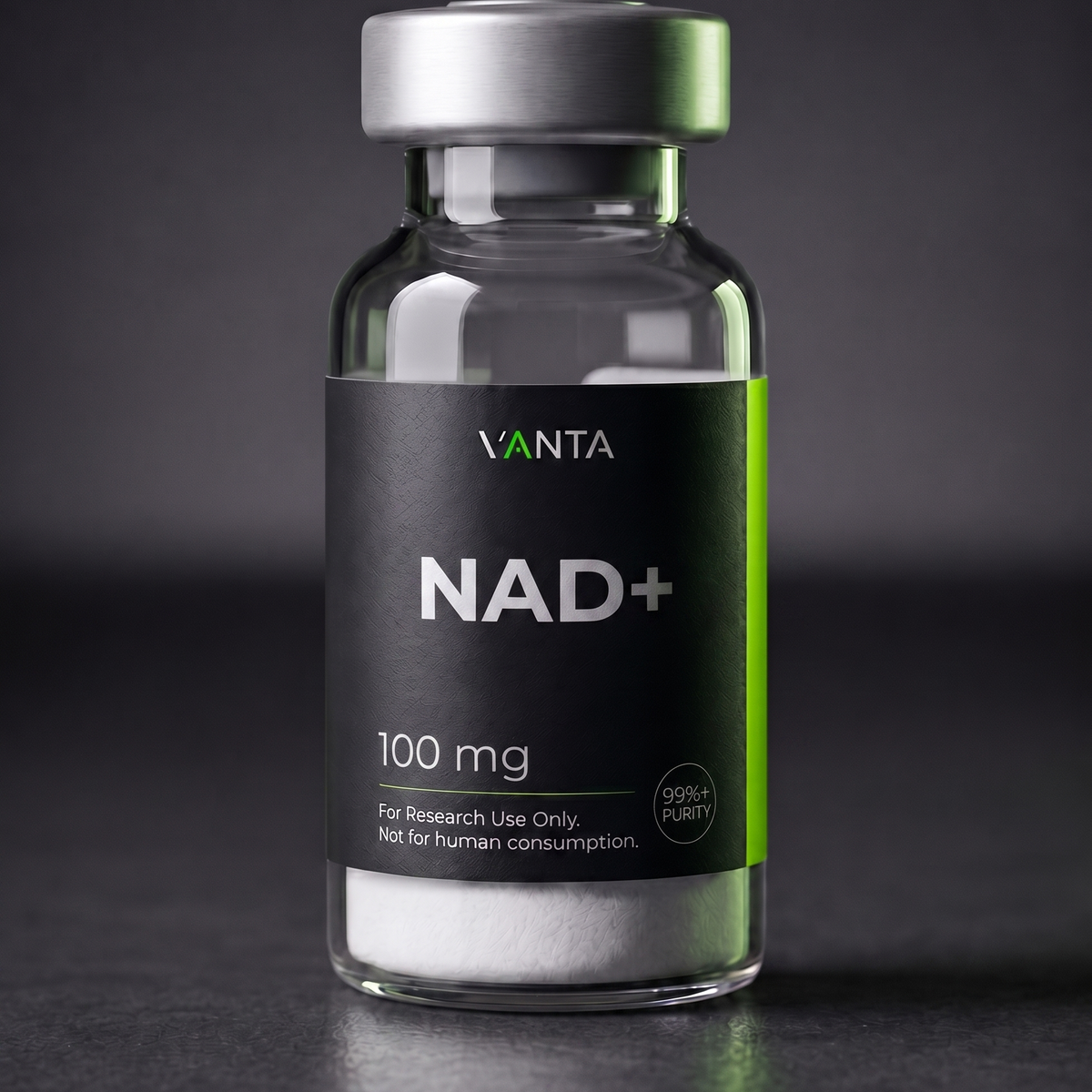
NAD+
Nicotinamide Adenine Dinucleotide
NAD+ is a helper molecule that sits inside every cell and is studied for its role in turning nutrients into usable energy. It works mainly in the mitochondria, the tiny power plants of the cell, where it helps run the reactions that keep energy flowing. Cells naturally hold less of it as they age, so it is also researched in models of cellular aging and DNA repair signaling.
Select size
Buy more, save more
Applied automatically by total quantity in your cart. Stacks with the 10% crypto discount.
Free US shipping. Ships from our US warehouse in 5-7 days - order today, arrives Jun 28 - Jun 30.
Best price online. Compare it anywhere - this is the lowest you will find.
Third-party tested. COA available for this batch (≥99% purity).
Crypto checkout. Pay with BTC, ETH, or USDC and save 10%.
Add bacteriostatic water to your order
Required to reconstitute peptides - not included.
Overview
NAD+ (nicotinamide adenine dinucleotide) is a pyridine dinucleotide coenzyme described in the literature as present in essentially all living cells. Researchers study this NAD peptide-adjacent reference compound for its role in redox chemistry, where it cycles between its oxidized form (NAD+) and reduced form (NADH). The literature characterizes it as a central cofactor in energy-related metabolic pathways and as a substrate consumed by several enzyme families, making it a frequently referenced metabolite in in-vitro biochemistry and animal-model work.
VANTA supplies research grade NAD+ as a lyophilized powder for laboratory research use only. Published reviews describe NAD+ as a cofactor and substrate for NAD+-consuming enzyme families including sirtuins, PARPs, and the glycohydrolase CD38, and situate it within pathways studied for DNA repair signaling, mitochondrial function, and cellular energy. One preclinical line of work reported that CD38 inhibition was associated with changes in tissue NAD+ levels in aged mice (Tarrago et al., Cell Metabolism, 2018), reflecting observations in laboratory models only.
Because NAD+ sits within a tightly interconnected metabolite network, analytical certainty about the test article is a prerequisite for interpretable data. Identity ambiguity between NAD+, NADH, and precursors such as NMN and NR can confound assays, so investigators sourcing NAD+ for research typically require documented identity and purity. Reviews summarizing this preclinical rodent literature consistently note limited and inconsistent translation to human clinical settings, an open question VANTA presents through primary citations without any efficacy or health claim.
Research Areas
Handling & Reconstitution
Ship and store VANTA NAD+ as a lyophilized powder at -20 degrees Celsius, protected from light to limit degradation. For laboratory reconstitution, researchers typically use a suitable sterile solvent and prepare working stocks immediately before an assay, since NAD+ and related metabolites are prone to breakdown in solution. Reconstitution and concentration parameters are determined by the investigator and the experimental protocol for research use only.
Frequently asked questions
What is NAD+?
NAD+ (nicotinamide adenine dinucleotide) is a pyridine dinucleotide coenzyme described in the literature as present in essentially all living cells. It is characterized as a central cofactor in energy-related metabolic pathways and as a substrate for NAD+-consuming enzyme families, and is studied as a reference compound in in-vitro biochemistry and animal models.
What form and purity is VANTA research grade NAD+ supplied in?
VANTA supplies NAD+ as a lyophilized powder characterized before release. Each lot is assessed by high-performance liquid chromatography (HPLC) for chromatographic purity and by mass spectrometry to confirm molecular identity against the expected mass, distinguishing the target from related metabolites and degradation products.
How should NAD+ be stored and reconstituted for research?
Store the lyophilized powder at -20 degrees Celsius, protected from light. For laboratory work, researchers reconstitute in a suitable sterile solvent and prepare working stocks shortly before an assay, since NAD+ and related metabolites degrade in solution. All handling parameters are set by the investigator for research use only.
Is VANTA NAD+ third-party tested and does it ship with a COA?
Yes. Every NAD+ lot is characterized using orthogonal HPLC and mass spectrometry methods, and each batch ships with a per-batch Certificate of Analysis (COA) documenting the measured purity and identity for that specific lot, so researchers can record provenance and analytical specifications in their own records.
What research areas is NAD+ studied in?
In preclinical and in-vitro literature, NAD+ is studied within pathways for mitochondrial function, cellular energy, and DNA repair signaling, and as a substrate for enzyme families such as sirtuins, PARPs, and CD38. These are descriptions of observations in laboratory models, not statements about any effect in people.
Is NAD+ intended for human use?
No. VANTA NAD+ is sold strictly for laboratory research use only. It is not intended for human or veterinary use, consumption, administration, diagnostic procedures, or any therapeutic application. All copy describes findings only as observed in research models and the primary literature.
Specifications
- Research Class
- Coenzyme
- Form
- Lyophilized Powder
- Storage
- Lyophilized: -20°C, protect from light.
For laboratory research use only. Not for human consumption, diagnostic, or therapeutic use. Must be 21+ to purchase.